
(Disclaimer: This article represents the views of the author, Prof Cruden, and does not necessarily reflect those of any individual or the wider group)
The FEVER project recently held a 2nd Policy Workshop in the Institution of Engineering and Technology (IET) Headquarters Building in Savoy Place, London on Monday 22nd June 2026, seeking to answer the question: “Can we help the Grid by developing off-grid clean power systems?”. This workshop, attended by representatives from SSEN, DfT, Hive Energy Ltd, the Faraday Institution, the IET, and members from each of the 4 FEVER consortium Universities, built on the success of an initial Policy workshop ran in November 2025.
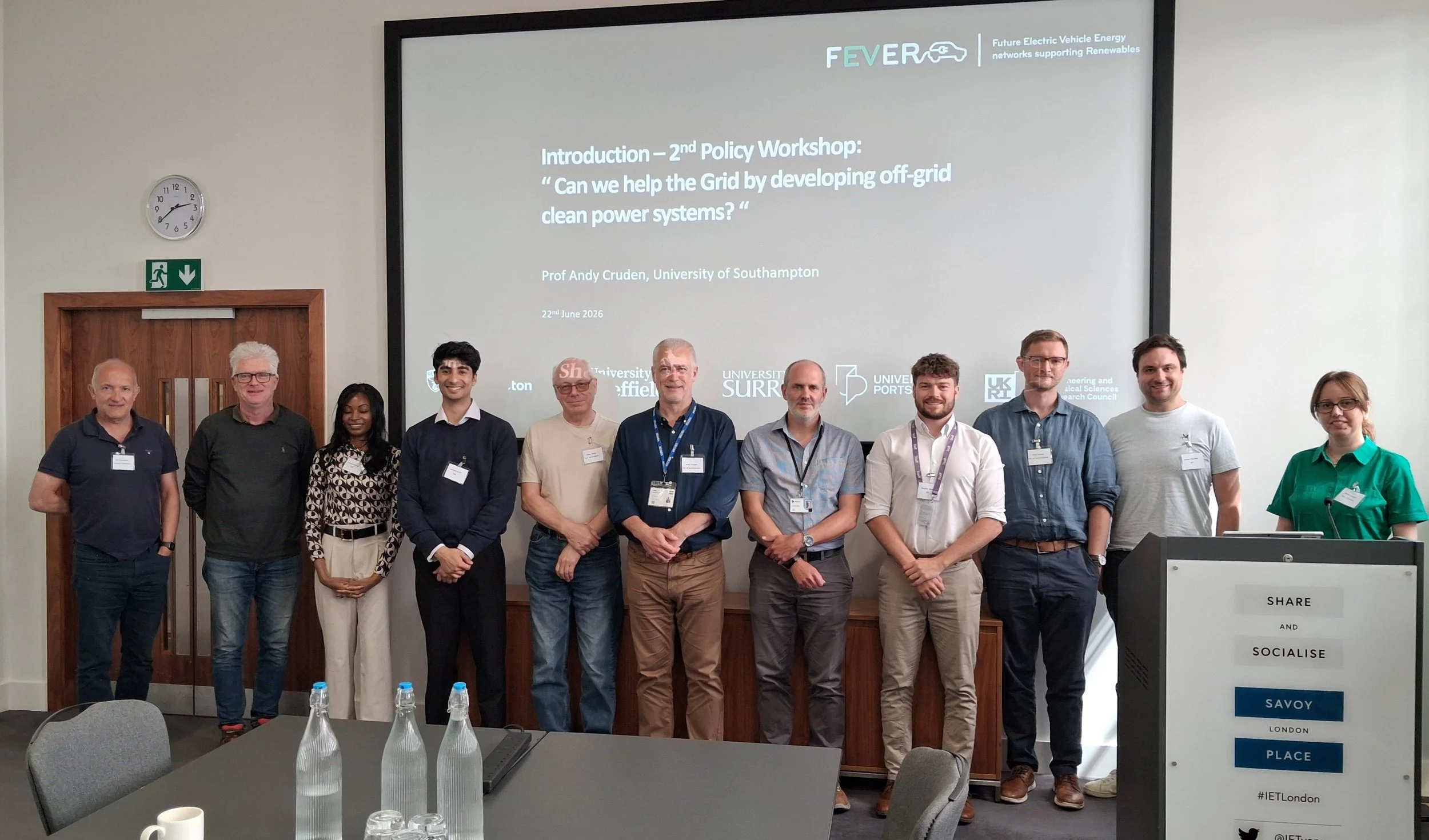
Figure 1: The 2nd Off-grid policy workshop, held at the IET, Savoy Place, London, had representatives from SSEN, DfT, Hive Energy Ltd, the Faraday Institution, the IET, as well as from the Universities of Sheffield, Portsmouth, Surrey and Southampton
This workshop discussed the current strategic direction for existing grid developments, now directed via NESO (National Energy System Operator) via both Regional Energy Strategic Plans (RESPs) and Local Area Energy Plans (LAEPs), where broadly the LAEPs are a ‘bottom up’ planning approach from Local Authorities and related agencies, and RESPs are seen as more ‘grid system top down’ planning activity. Within these approaches there is no explicit mention or promotion of the potential of ‘off-grid’ power systems, both to deliver specific load types e.g. EV charging, nor of the positive impact of offsetting these loads from not connecting to the grid and hence not compounding demand capacity constraints, connection planning and operation.
Some related comments highlighted that creation/operation of NESO has actually slowed the connection process even further for new developments, and added in additional layers of complexity, uncertainty and process. Clearly this may be whilst NESO develops and implements their new planning processes however this does seem to have moved focus from new developments to consideration of re-powering existing older projects.
Further policy initiatives, such as the Warm Homes Plan (https://www.gov.uk/government/publications/warm-homes-plan/warm-homes-plan-html) and local and community energy schemes via GB Energy, are seeking to implement a step change in domestic/commercial solar and storage systems, capable of permitting more local use of renewable generation, and could be extrapolated to considering new housing developments offering entirely net-zero local energy systems for both power and heating, from local renewables, storage and district heating. Such developments clearly offer scope for fully off-grid development and operation and Government should recognise and support such options, in addition to further G100 developments that seek to fully utilise, and manage, capacity on existing grid connections.
The laudable aim of GB Energy to support the development of up to 8 GW of local and community energy projects is clearly a positive signal, however the justification behind this target is not clearly evidenced nor does GB Energy’s currently stated target to support only 1,000 such local/community projects by 2030 reconcile with an ambition to deliver the 8 GW level. Further, there is again no specific mention that off-grid power systems could and should play a part in such delivery, rather a continued focus on only delivering grid-connected projects.
The current Government Call for Evidence “Assessing the case for community batteries” (https://www.gov.uk/government/calls-for-evidence/assessing-the-case-for-community-batteries/assessing-the-case-for-community-batteries-call-for-evidence-accessible-webpage#general-information) does seeks to gather information on the community batteries landscape, the opportunities and benefits, the barriers to delivery and how safety can be ensured. This is a positive step and it is hoped that fully off-grid power systems, with electrical energy storage, can ultimately be promoted and supported following sufficient evidence.
Finally, as of the date of this post, the awards of the recent DfT/Innovate-UK funded competition Call in Nov 2025 (https://www.gov.uk/government/news/10-million-for-cutting-edge-tech-to-help-futureproof-englands-electric-vehicle-chargepoint-supply-and-keep-drivers-moving), which sought innovative solutions and technologies to speed up the chargepoint rollout on motorways and major A-roads, are still awaited. This competition was unique in that it would "allow electric vehicle charging devices to operate without large grid connections or even off-grid", and understanding the industry/developer response to such a Call will hopefully indicate the current appetite for possible off-grid solutions.
As per the previous FEVER policy workshop, that focussed on exploring support and opportunities for off-grid power systems, the outcomes of this workshop will be pursued, collated and analysed and further discussion and evidence will be presented to government, industry and related stakeholders in due course.
In the meantime, the FEVER Team will continue to seek and respond to any response or query relating to the potential of off-grid power systems. Please feel free to contact us on info@fever-ev.ac.uk.